Walmart Connect Playbook for Emerging CPG Brands
Smaller CPG brands can still win on Walmart Connect. Discover the moves that make retail media work harder.


Every week, around 150 million customers shop across Walmart stores and online. This makes Walmart Connect one of the largest retail media platforms in the US. It gives CPG brands the chance to reach shoppers while they're actively deciding what to buy.
Unlike traditional digital advertising, these shoppers are much closer to making a purchase. They are already comparing products, reading reviews, checking prices, and adding items to their carts.
Many emerging brands assume Walmart Connect works the same way as Google Ads, Meta campaigns, or other paid search platforms. But unfortunately, it doesn't.
Success on Walmart Connect depends heavily on retail readiness. Strong product listings, competitive pricing, inventory availability, and customer reviews all influence campaign performance alongside your advertising strategy.
This playbook shows you how to approach Walmart Connect with that reality in mind. It's built for emerging CPG brands that want to compete in crowded categories without an enterprise-level budget or a dedicated retail media team.
What Is Walmart Connect and How Does It Work?
Walmart Connect is Walmart’s retail media platform and one of the largest retail media networks in the U.S., behind Amazon. It gives CPG brands the ability to advertise across Walmart's website, app, physical stores, and now living room screens, all tied to one of the richest first-party data sets in retail.
This scale matters because Walmart reaches shoppers in places where purchase decisions already happen. Walmart says its stores and clubs are within 10 miles of roughly 90% of the U.S. population.
Also, Walmart Connect gives advertisers access to Walmart’s first-party data, which comes from real shopping behavior across digital and in-store touchpoints.
For emerging CPG brands, this changes how you plan media.
On Google, Meta, or social platforms, you are usually reading intent signals from searches, clicks, views, and engagement.
However, on Walmart Connect, your campaigns can connect back to Walmart’s own transaction data. This helps you see how ad spend links to purchases across online and in-store sales.
Core Walmart Connect Ad Formats
Before you set budgets or pick campaign goals, you need to understand what each Walmart Connect ad format is built to do. Some formats capture shoppers who are already searching on Walmart.com. Others help you reach people earlier through display, off-site media, connected TV, and in-store placements.
For emerging CPG brands, the key is simple: match the format to the job. Start with the placements closest to purchase, then expand once your listings, budget, and measurement are ready.
Sponsored Products
These are pay-per-click ads that appear in search results, category pages, and product detail pages. This is where most emerging CPG brands should start.
A shopper searching "high-fiber pasta" or "gut health supplement" is already in buying mode. Sponsored products put your SKUs in front of that shopper at the right moment.
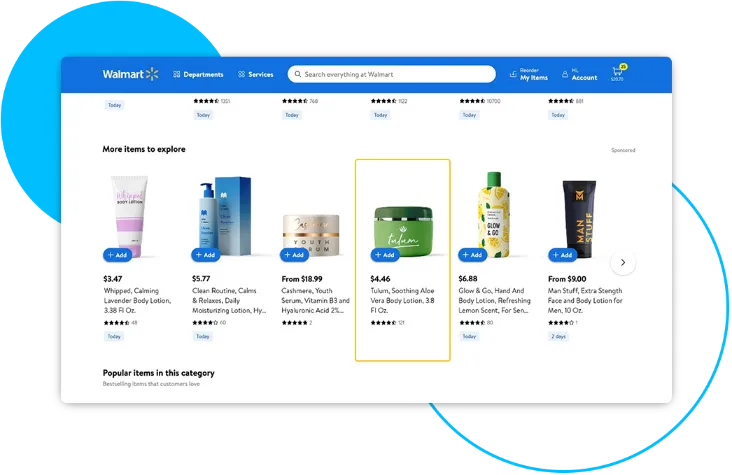
The example below shows how sponsored products appear within Walmart's shopping experience. Instead of interrupting shoppers, these ads appear alongside similar products while customers compare options and decide what to buy.
Sponsored Brands
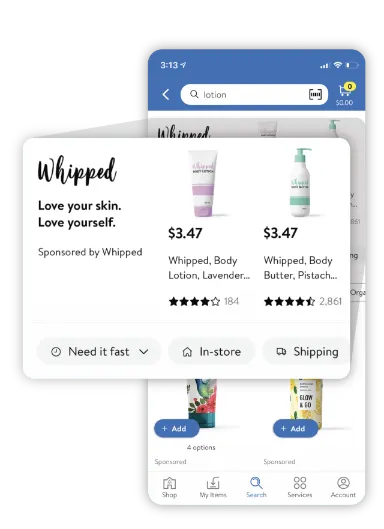
Sponsored brands are ads that appear at the top of Walmart search results. They can feature your logo, a custom headline, and up to four products.
This format helps shoppers notice your brand before they click into a competitor’s product page. For emerging CPG brands, that matters in crowded categories where shoppers may recognize the problem before they recognize your brand.`
Walmart Connect reports that 69% of Sponsored Brands orders come from new-to-brand buyers. This makes it a useful format when your goal is to grow your customer base and earn consideration beyond your existing audience.
Sponsored Brands is at the top of search results and features your logo, a custom headline, and up to four products. They serve a mid-to-upper funnel role and build consideration before a shopper clicks into a competitor's page.
Sponsored Videos
These are short, keyword-targeted video ads that auto-play directly within Walmart's search results. They run between 5 and 45 seconds, and a click anywhere on the video takes the shopper straight to your product detail page.
Onsite Display
This ad format puts banners and visual ads in front of shoppers across Walmart's site and app, outside of search results. Think homepage placements, category browse pages, and product detail pages. You're reaching people who are already on Walmart but haven't searched for your product yet.
Offsite Media
Offsite Media extends your reach beyond Walmart's site and app entirely. You can place programmatic ads across Connected TV, social platforms like Meta, TikTok, and Pinterest, audio, and gaming, all using Walmart's first-party shopper data for targeting.
Every impression, regardless of where it runs, ties back to Walmart purchase data so you can measure sales impact.
In-Store Advertising
In-Store Advertising helps you connect with Walmart customers while they shop across Walmart's 4,600+ U.S. locations.
These formats reach shoppers from the entrance, through the aisles, and past checkout to build awareness and consideration at the moment purchase decisions are being made. For CPG brands with physical shelf presence, in-store ads can reinforce what your digital advertisements are already doing.
Why Emerging CPG Brands Struggle With Walmart Connect
Many brands assume poor campaign performance means Walmart Connect is too competitive or advertising costs are too high. In our experience, the root cause usually appears much earlier.
Some of the most common challenges we see are:
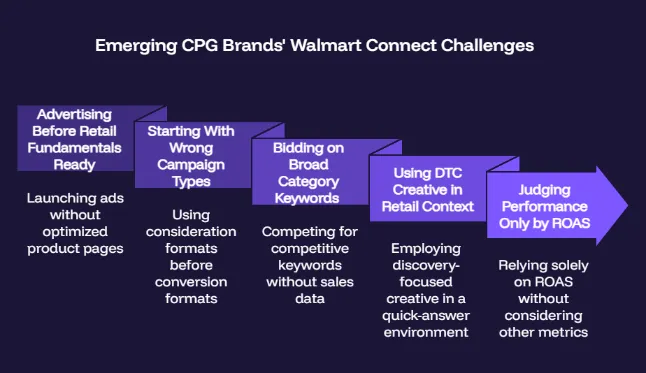
1. Advertising Before The Retail Fundamentals Are Ready
Walmart Connect is an amplifier, and that cuts both ways. If a shopper clicks your ad and the product page has one blurry image, a thin description, and a price that's out of step with the category, they leave. You paid for that click and got nothing from it.
Product attributes also deserve attention. Missing or incomplete attributes limit discoverability and reduce the quality of search matching.
If Walmart cannot confidently understand your product, it becomes harder for the platform to serve your ads to the right audience.
2. Starting With the Wrong Campaign Types
The instinct for many brands is to run everything at once. Sponsored Products, Sponsored Brands, and Display, all from day one across every SKU in the catalog. Doing this spreads your budget too thin to generate meaningful data on anything.
Sponsored Brands and Display are consideration formats that work best when shoppers already know your brand. Running them before Sponsored Products has generated any sales data means you're spending money on awareness for a product that hasn't proven it can convert yet.
3. Bidding on Broad Category Keywords Too Soon
We’ve seen new brands go after the most competitive keywords in their category right out of the gate.
A brand with little to no sales on the platform will lose those auctions to established players or win them at a cost that makes the ROAS math impossible.
The smarter move early on is to use automatic campaigns. Let Walmart's algorithm surface the search terms your product converts on, then graduate the winners to manual campaigns with tighter control.
4. Using DTC Creative in a Retail Buying Context
A Walmart shopper in search results is not in the same headspace as someone scrolling Instagram or TikTok. DTC campaigns are built for discovery, storytelling, and aspiration.
Whereas Walmart shoppers behave differently. They want quick answers.
- What is the product?
- How large is it?
- What flavor is it?
- How many units are included?
- Why should I choose this one instead of the alternatives?
Your product spec and value need to be front and center. The brand story can come later, once the shopper is already on your product page.
5. Judging Performance Only by ROAS
ROAS remains one of the most important metrics in retail media. But it shouldn’t be the only metric guiding your decisions in the early stages of a campaign.
A new brand on Walmart with low sales velocity, thin review counts, and a short purchase history is not going to produce strong ROAS in the first few weeks. This doesn't mean the campaign isn't working.
Metrics like new-to-brand customers, retail search share of voice, sales velocity, and total Walmart business growth tell a more complete story of how your ads are performing. We’ll cover more on this later in the article.
How to Run Walmart Connect the Right Way
Setting up a Walmart Connect campaign is the easy part. Profit comes from stronger retail fundamentals, a cleaner campaign structure, and a clear test plan.
Here is the framework we recommend.
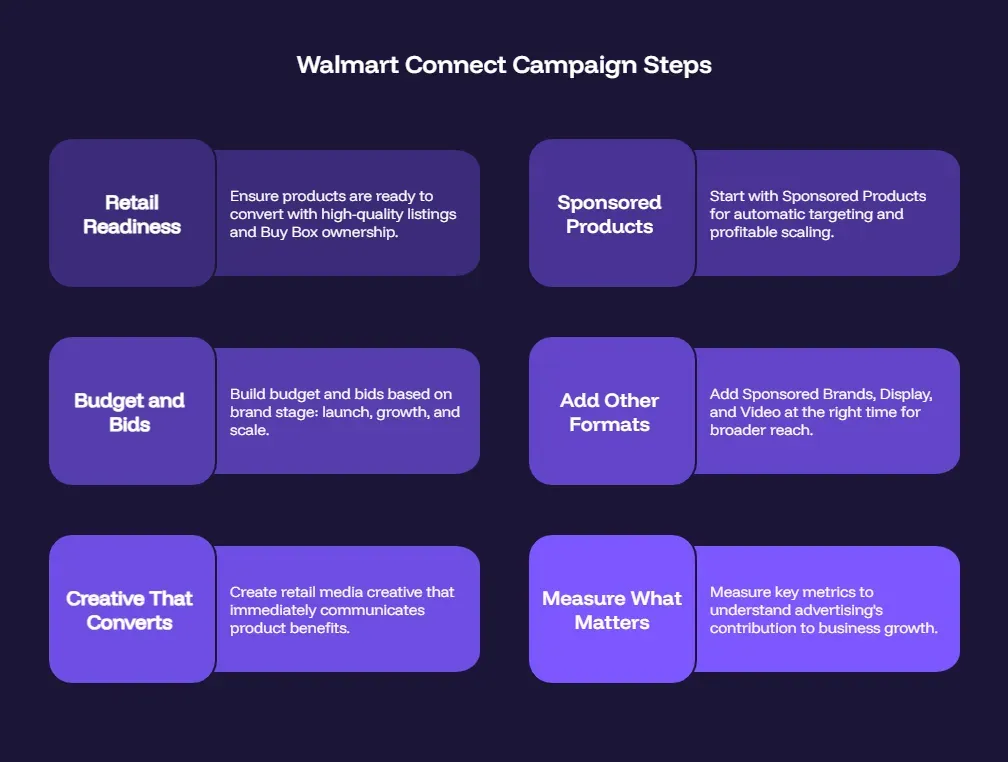
Step 1: Fix Retail Readiness Before Spending
Before you launch, your products need to be ready to convert.
Walmart’s own guidance recommends a listing quality score of 80% to 100% in Seller Center. Start with your best-selling items. Make sure each listing has a clear product title, accurate attributes, multiple high-quality images, and a description that answers the questions a shopper would ask before purchase.
You also need to hold the Buy Box on every SKU you plan to advertise. On Walmart, more than one seller can list the same product. The Buy Box is the default "Add to Cart" button shoppers see.
If another seller holds the Buy Box, your ads may send traffic to a page where that seller gets the order. Walmart’s Repricer tool can help you stay price-competitive and protect that position.
Step 2: Start With Sponsored Products
For most emerging CPG brands, Sponsored Products should be the first campaign type you launch.
Sponsored Products place your items directly in front of shoppers searching for relevant products across Walmart's site and app. Walmart also recommends automatic campaigns for advertisers who are new to the platform. The algorithm will match your products to relevant search terms based on your listing content and purchase history.
After 2 to 4 weeks, pull your search term report and identify what's converting. You can then use those terms in manual campaigns where you have full control over bids and match types.
In fact, according to Walmart, Sponsored Products campaigns using automatic targeting deliver 1.7x higher ROAS than comparable manual-only campaigns. This makes the auto-to-manual transition your absolute best opportunity to scale profitably early on.
Step 3: Build Budget and Bids by Brand Stage
Your strategy needs to match where you are at Walmart.
Launch stage
At the launch stage, the goal is learning. Here, we suggest keeping budgets concentrated on your priority SKUs and gathering enough data to understand which products, keywords, and audiences generate conversions.
Growth stage
At this stage, increase your investment in campaigns that consistently perform well. Expand winning keywords, raise bids where appropriate, and introduce additional high-potential SKUs.
Scale stage
Once your retail readiness and Sponsored Products performance are stable, you can pursue broader category keywords, additional placements, and full funnel marketing campaigns.
This is where Display, Video, and Offsite Media start to make sense because your search foundation is strong enough to support them.
Step 4: Add Sponsored Brands, Display, and Video at the Right Time
Sponsored Brands make sense when you have multiple strong SKUs and a clear brand story to tell at the top of search results. If you only have one converting product and thin brand recognition on Walmart, this format will likely underdeliver.
Display works best for retargeting shoppers who have already visited your product pages. Use it for seasonal pushes where you need broader reach, and for audience expansion once search is performing consistently.
Sponsored Videos help educate shoppers when your product benefits from a visual demonstration. This is useful for innovative products or categories where customers may need additional context before making a purchase.
Step 5: Create Retail Media Creative That Converts
Walmart shoppers in search results are moving fast and comparing options. As we mentioned earlier, your creative should immediately communicate what the product is and why someone should choose it.
Lead with these in every format:
- Show the product immediately
- Make the category obvious from the first frame
- Lead with the key benefit, not the brand name
- Include pack size, flavor, count, or usage occasion
A shopper looking for a high-fiber snack bar needs to see "20g fiber" before they see your logo.
Step 6: Measure What Matters
These metrics help you understand how advertising contributes to broader business growth across Walmart.
- ROAS and incremental ROAS
- New-to-brand orders
- CPC and CTR
- Conversion rate
- Product velocity
- Organic rank movement
- Total Walmart sales
- Customer retention rate among first-time buyers
New-to-brand orders are part of Walmart Connect's new-to-brand metrics. They show how many first-time customers your campaigns acquire, giving you a clearer picture of customer acquisition beyond repeat purchases.
How to Scale Walmart Connect Without Burning Budget
Scaling before your foundation is stable is one of the fastest ways to waste budget on Walmart Connect.
So before increasing spend, we suggest checking these five signals:
- Inventory is stable, and you are not going in and out of stock
- Your product detail pages (PDPs) have strong conversion rates relative to category benchmarks
- Sponsored Products campaigns are generating consistent attributed sales
- You have enough reviews to give new shoppers confidence
- You have clear winning SKUs with proven performance data behind them
If several of these areas still need work, focus on strengthening them before expanding your investment.
Smart Walmart Connect Scaling Levers
Once your campaigns are producing consistent results, you can begin expanding strategically.
Start by adding new keywords based on search terms that have already demonstrated strong conversion. Increase bids on proven keywords instead of raising bids across every campaign.
Next, introduce additional SKUs that have strong retail readiness and align closely with your existing campaign structure.
If your products are available in physical stores, consider complementing digital campaigns with in-store promotions. Coordinating online and in-store activity can strengthen brand awareness while supporting overall retail performance.
The key is to introduce one or two scaling levers at a time. This approach makes it much easier to measure what is contributing to growth.
Walmart Connect Scaling Mistakes to Avoid
Growing your Walmart Connect program should feel controlled. When you try to scale too quickly, campaign efficiency suffers.
Scaling before inventory is stable
Running ads for a product that keeps going out of stock wastes spend and signals poor reliability to Walmart's algorithm. Stockouts during a scaled campaign can set back your organic ranking significantly.
Adding too many SKUs too quickly
Every new SKU introduces another variable to manage. So, focus on products that already have strong retail readiness and proven demand before expanding your catalog.
Ignoring search term data
Your search term reports contain valuable insights about shopper intent. Brands that review them regularly can identify new keyword opportunities, remove underperforming terms, and refine campaign structure as they grow.
Treating Walmart like Amazon
Although both platforms operate within the retail media space, they have different shoppers and search behavior. A campaign structure that performs well on Amazon Ads may require significant adjustments before it delivers comparable results on Walmart Connect.
Real-Life Successful Examples of Walmart Connect
One of the best ways to understand Walmart Connect is to see how other retailers have used it to solve their growth challenges. These three sellers show what Walmart Connect looks like in practice across different business types and growth stages.
Sweet Hearts
Sweet Hearts, an apparel brand led by father-son duo David and Hymie Gindi, used Sponsored Search to support a seasonal campaign. The team analyzed which keywords resonated with shoppers and refined their campaigns based on those insights.
This strategy resulted in a 9% increase in conversion rate. This shows why search data should guide campaign optimization.
As Hymie Gindi put it:
"It's not about pushing a product that a consumer will find, but pushing a product that a consumer is looking for."
STS Recycling
STS Recycling sells refurbished electronics on Walmart Marketplace. Its catalog changes constantly as new inventory arrives. The main challenge was steady sales throughout the year and enough visibility for newly added products from day one.
To stay visible, STS Recycling ran always-on automatic Sponsored Products campaigns for its core catalog. For new products, the team used manual campaigns with more aggressive bids to create early momentum. The result was an 87% year-over-year increase in sales and a return on ad spend 6% above their target.
TRUBAR
TRUBAR combined multiple Walmart Connect solutions to support both online and in-store growth. The brand started with Sponsored Products campaigns to identify the search terms that drove the most sales.
As performance improved, TRUBAR expanded into Sponsored Videos to increase awareness and paired its digital strategy with in-store demos and sampling across 667 Walmart stores.
The results were impressive. Sponsored Products helped sell 17,000 units, Sponsored Videos generated 5 million impressions and drove 60.5% new to brand orders, while the overall campaign produced a 30% month-over-month increase in sales.
How 9AM Can Help You Win With Walmart Connect
Running Walmart Connect well means managing retail readiness, campaign structure, creative, bidding, and measurement at the same time. Most emerging CPG brands don't have the bandwidth to do all of that internally, and gaps in any one area show up quickly in wasted spend.
If your Walmart Connect campaigns are underperforming or you are preparing to launch for the first time, book a strategy session with 9AM. We will review your retail readiness, identify growth opportunities, and build a roadmap that helps you scale with confidence.
FAQs
Is Walmart Connect worth it for emerging CPG brands?
Yes, provided your retail fundamentals are already in place. Walmart Connect can accelerate product discovery and sales, but advertising works best when inventory, pricing, PDPs, and reviews are optimized.
What is the best Walmart Connect strategy for a new CPG brand?
Most emerging CPG brands should start with Sponsored Products before they expand into display and video. Search-based placements capture existing demand, create faster learning, and give you a clearer path to sales.
Once your brand has a baseline of performance, broader audience targeting and awareness campaigns can help you reach new shoppers and support further growth.
How much should emerging brands spend on Walmart Connect?
Emerging brands should plan for at least $100 per day on a Sponsored Products test. Walmart recommends this minimum daily budget to maintain visibility during peak shopping hours and build momentum.
This means your first test should usually have about $1,400 to $2,800 available for a two to four week learning period. Use that budget around a small group of priority SKUs, then review search terms, CPCs, conversion rate, and ROAS before you expand.
What metrics matter most in Walmart Connect?
While ROAS is important, it should not be the only success metric. You should also evaluate incremental sales, new-to-brand customers, product velocity, and overall Walmart business growth. The strongest Walmart Connect programs balance short-term efficiency with long-term market share gains.
Should brands prioritize Walmart Connect or Amazon Ads?
The answer depends on where the business has the greatest opportunity for retail growth. Brands with strong Walmart distribution may find that Walmart Connect offers a more efficient path to visibility and sales. In many cases, brands use both platforms as part of a broader retail media strategy, with channel investment aligned to business objectives.
When should brands invest in Walmart Connect display and video advertising?
Display and video typically become more effective once Sponsored Search campaigns are generating consistent results. These upper-funnel formats help you expand reach, build brand awareness, and introduce products to new audiences. However, they generally perform best when supported by strong search coverage and optimized product detail pages.
How important are product detail pages to Walmart Connect performance?
Product detail pages are one of the biggest drivers of advertising efficiency. Even the best campaign strategy can struggle if shoppers encounter weak images, limited product information, or poor reviews. At 9AM, PDP optimization is one of the first areas we evaluate before increasing media investment.
How does 9AM approach Walmart Connect for emerging brands?
At 9AM, we focus on connecting retail readiness, performance media, and measurement into a single growth framework. Rather than optimizing solely for platform metrics, we evaluate how Walmart Connect contributes to broader business outcomes, including sales growth, customer acquisition, and long-term brand development
Appendix
- https://www.walmartconnect.com/about
- https://www.statista.com/topics/12250/walmart-connect/
- https://www.walmartconnect.com/solutions/sponsored-brands
- https://www.walmartconnect.com/solutions/store-ads
- https://www.walmartconnect.com/insights/retail-readiness
- https://www.walmartconnect.com/resources/articles/2025/lets-grow-2025-seller-summit
- https://www.walmartconnect.com/resources/case-studies/2025/new-fashion-styles-won-new-hearts
- https://www.walmartconnect.com/resources/case-studies/2025/roas-strategy-as-sustainable-as-the-year-round-demand-it-set-in-motion
- https://www.walmartconnect.com/resources/case-studies/2025/how-a-brand-raised-the-bar-from-cravings-to-conversion