Retention Marketing for Acquisition-Obsessed Teams
Retention marketing turns acquisition‑obsessed teams into growth engines as they amplify lifetime value, optimize loyalty, and drive sustainable revenue.

Most growth teams are wired for acquisition. The metrics are cleaner, the wins are more visible, and there's always another campaign to run.
But somewhere between the first touchpoint and the second invoice, most teams have no real plan for what happens next. Onboarding becomes an afterthought. Check-ins sound automated and hollow. Feedback gets collected, stored, and rarely turned into action.
This leak is getting harder to ignore. A 2025 Adobe and Publicis Sapient report found that acquisition costs rose 35% from 2022 to 2025, while customer lifetime value grew only 4.5%. Acquisition can fill the top of the funnel, but retention decides how much revenue actually stays.
Retention helps you build customers who return, spend more, and recommend your brand. Meanwhile, acquisition keeps getting more expensive, particularly when campaigns attract people who respond to a discount, make one purchase, and leave before the relationship has time to grow.
This article breaks down the mindset shift retention really requires (the one most teams skip), the strategies that create durable customer value, and the metrics that show what is actually working.
P.S. If you want stronger retention marketing strategies that connect customer experience, lifecycle marketing, and loyalty mechanics, 9AM can help. We help you improve LTV modeling, increase repurchase rates, and build more durable revenue through growth systems built around retention.
TL;DR: What You Can Learn
- Retaining a customer costs a fraction of acquiring a new one, yet most brands underinvest in it while continuously spending to replace lost customers.
- You should earn retention first, then deepen it into loyalty.
- High churn quietly destroys profitability; 65% of revenue comes from existing customers.
- The main retention levers are lifecycle marketing, personalized messaging, loyalty programs, subscriptions, customer experience, and win-back campaigns.
- Strong retention raises CLV, improves the CLV:CAC ratio, and makes paid acquisition more profitable without increasing spend.
- Retention doesn't compete with acquisition; it's what makes acquisition worth running.
What Is Retention Marketing?
Retention marketing is the discipline of keeping existing customers engaged, driving repeat purchases, and turning satisfied customers into loyal advocates. Where acquisition asks "how do we get them in?", retention asks "how do we make staying the obvious choice?"
This difference matters because existing customers are usually easier and more profitable to convert. In fact, data shows that selling to existing customers typically has a 60% to 70% success rate, while selling to new prospects typically has a 5% to 20% success rate. So when teams ignore retention, they leave a warmer audience underused while spending more to reach colder buyers.
Cost makes the case even clearer. Acquiring a new customer can cost 5 to 25 times more than keeping an existing one. In SaaS, it can also take 1 to 5 years before a customer becomes profitable, depending on acquisition cost, onboarding time, contract value, and churn risk.
Plus, the upside can be significant. Even a 5% increase in retention can increase profits by 25% to 95%, depending on the business model and margin structure. Loyal customers are also 50% more likely to repurchase and 86% more likely to refer, which means retention can support repeat revenue and word-of-mouth growth at the same time.
Here are the key differences between retention marketing and acquisition marketing:
Retention Marketing vs Acquisition Marketing
| Factors | Retention Marketing | Acquisition Marketing |
|---|---|---|
| Core goal | Keep existing customers engaged, loyal, and buying again | Attract new customers and convert them into first-time buyers |
| Target audience | Past and current customers you already know | Prospects and cold leads who have not bought yet |
| Cost and efficiency | Builds from existing customer data, purchase history, and active relationships | Often needs higher spend across ads, promotions, partnerships, and sales activity |
| Typical tactics |
Email flows
SMS flows
Loyalty programs
Post-purchase follow-ups
Personalized recommendations
Re-engagement campaigns
|
Paid ads
Influencer campaigns
Top-of-funnel content
PR
Partnerships
Lead magnets
|
| Messaging style | More targeted because it uses known behavior and customer context | Broader because it needs to reach people who may not know the brand yet |
| Business impact | Increases repeat purchase rate, purchase frequency, referrals, and customer lifetime value | Creates new demand, expands reach, and opens new revenue opportunities |
Retention vs Loyalty
Retention tells you customers are still buying. Loyalty tells you they have a reason to keep choosing you. This distinction matters because repeat purchases can come from contracts, discounts, habit, or switching friction. Loyalty goes deeper because the customer sees enough value to stay even when another option looks cheaper.
However, you should earn retention before chasing loyalty. If onboarding is weak, product value feels unclear, or churn stays high, loyalty campaigns can only do so much. First, make the customer experience worth repeating. Then loyalty mechanics, referrals, and advocacy programs have something real to build on.
Why Acquisition-First Teams Underestimate Retention
Churn is rarely just a retention problem. For acquisition-focused brands, it's a growing financial drain hiding in plain sight.
U.S. businesses lose an estimated $1.6 trillion annually to customer churn, and they keep spending to replace what they're losing. Plus, acquiring a new customer now costs around $536 in B2B to $1,450 in fintech.
This pressure creates a hard ceiling on growth. Acquisition-focused teams typically end up with high CAC and too-low CLV, resulting in a CLV ratio well below 3:1, dangerously close to or below 1:1.
You can make acquisition more efficient, but that only solves part of the problem.
When we partnered with GenomeLink, a DNA analysis platform competing in one of the more crowded corners of consumer health tech, the brief was straightforward: scale user acquisition without letting CAC spiral.
Over three years, we built a systematic approach to creative production. Our team produced 70+ unique assets monthly across six formats. Then we combined that creative volume with rigorous cross-platform optimization and conversion testing.
This approach delivered a 77% reduction in customer acquisition cost. The same budget went significantly further, and the unit economics started working in their favor.
Still, CAC reduction alone does not finish the growth equation. Retention is what helps CLV get where it needs to be because it turns first-time customers into repeat revenue without requiring more acquisition spend.
Why Retention Marketing Matters for Business Growth
The following reasons show why retention marketing has become a core growth lever for teams that want stronger margins, better customer value, and more predictable revenue.
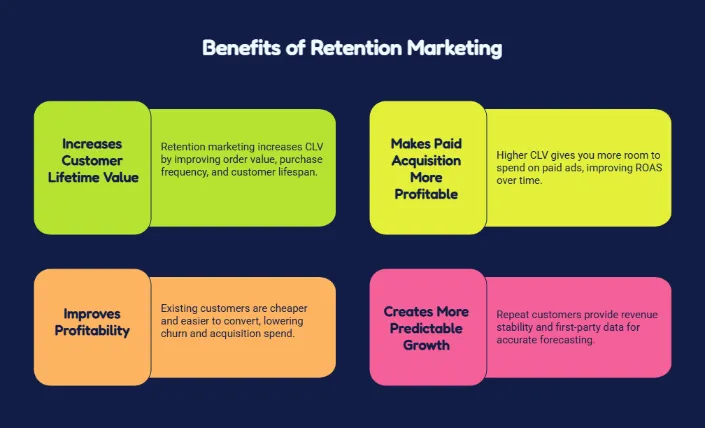
1. Increases Customer Lifetime Value (CLV)
Every customer comes with an acquisition cost. Retention is how you earn it back.
CLV shows the total value a customer creates throughout the relationship. It usually depends on three core levers: average order value, purchase frequency, and customer lifespan.
Retention marketing works across all three levers. It can increase order value through smarter recommendations, improve purchase frequency through timely follow-ups, and extend customer lifespan through better onboarding, support, and customer experience.
This matters because a customer usually becomes more valuable after the first purchase. They understand the product better, need less persuasion, and give your team more behavioral data with every interaction.
Each repeat purchase creates stronger signals around preferences, habits, timing, and buying patterns. That data helps teams make the next message more relevant and the next sale more likely.
That’s why better retention makes every acquisition dollar work harder.
For a deeper breakdown of the early customer moments that shape repeat purchase behavior, read Post-Purchase Moments That Raise LTV in 30 Days
2. Makes Paid Acquisition More Profitable
Paid ads get expensive fast when customers only buy once. The channel economics only work when acquired customers keep coming back.
Higher CLV gives you more room to spend without weakening ROAS.
- On Google, this can mean bidding more competitively for high-intent searches.
- On Meta, retention data can help identify your best customers and improve audience signals.
- On TikTok, loyal customers can extend paid performance through repeat purchases, organic sharing, and stronger product recall.
So even if the first purchase ROAS stays flat, retained customers can improve total ROAS over time. The acquisition campaign brings the customer in, but retention determines how much value that customer creates afterward.
3. Improves Profitability
Existing customers understand the product and need far less convincing the second time around. This makes them considerably cheaper and easier to convert than someone who's never heard of you.
Strong retention lowers churn, which means fewer customers need replacing. As a result, the acquisition spend can focus on genuine long-term growth instead of constantly filling the gaps left by lost customers.
Profitability improves because retained customers usually create more revenue with lower incremental cost. They need less education, move faster through the buying journey, and usually require fewer resources to convert again.
4. Creates More Predictable Growth
It’s not just that your existing customers know your brand well; you know them well, too. Their purchase history, preferences, and behavior patterns give you a deep understanding that’s hard to replicate with new audiences.
Repeat customers create revenue stability that makes budgets, inventory, and staffing easier to plan. And the first-party data they generate (purchase habits, preferences, service interactions) feeds AI-powered analytics that help you anticipate needs and forecast future behavior more accurately.
Retention Marketing Channels That Actually Deliver
The best retention channels do more than keep your brand visible. They help customers get more value after the first purchase, remind them at the right moment, and make the next step easier.
The following channels are usually the strongest starting points.
Email gives you a direct, low-cost line to customers after the first purchase. It nudges repeat orders, reduces churn, surfaces useful feedback, and keeps the relationship warm.
Unlike paid acquisition, you're not paying to reach people you already earned. Email marketing generates around $36 ROI for every $1 spent, far outperforming Google Ads’ $2 return.
SMS
SMS works best when timing matters. Messages get read within minutes, which makes it the right tool for flash sales, reorder reminders, and loyalty nudges, where waiting 48 hours for an email to open doesn't cut it.
The numbers back this up: SMS carries a 98% open rate and a 45% response rate. This reach matters particularly for short, action-oriented messages, like "you're 10 points from a reward" or "your usual is due soon".
Social Media
Social media supports retention when it turns customers into active participants instead of passive followers. People stay closer to a brand when they feel heard, see their stories reflected, and know the comments section gets real attention.
Community spaces can also give customers a stronger reason to stay connected between purchases. Social listening adds another layer because casual comments, complaints, and product questions can reveal what customers actually want next.
The strongest retention tactics usually include resharing customer stories, responding quickly to useful feedback, creating follower-only moments, and hosting community events for engaged customers.
These actions make the relationship feel more personal, which helps customers stay connected after the first sale.
LEGO’s fan programs show how strong communities can turn repeat buyers into active participants who keep the brand relationship alive.

Paid Retargeting
Paid retargeting helps you reach past purchasers, lapsed customers, cart abandoners, and high-value segments with more relevant messages. Instead of using paid media only to chase new buyers, teams can use it to drive repeat purchases, upsells, replenishment reminders, and win-back campaigns.
It also gives retention teams faster feedback. Campaign data can show which offers, messages, products, and audiences respond best. These insights can then improve email, SMS, lifecycle flows, and the broader retention strategy.
Push Notification
A push notification shows up wherever the user is, which makes timing everything. They work best when the message connects to a clear behavior, such as onboarding progress, abandoned activity, reward status, product usage, or a timely reminder.
The retention impact is most pronounced early in the customer relationship. Data show that sending a push in a user's first week can increase retention by 71%, and consistent use in the first 90 days can more than double the number of people who stick around.
The catch is that the format demands discipline. You only have a few words and one chance to feel relevant before a customer mutes alerts or starts ignoring them completely.
Core Retention Marketing Strategies
Good retention does not come from sending more messages. It comes from understanding where customers slow down, what they need next, and which moments can turn a first purchase into an ongoing relationship.
Below, we have shared some strategies that can help you improve onboarding, repeat purchases, customer value, and long-term engagement without relying only on new traffic.
1. Lifecycle Marketing
Lifecycle marketing treats the customer relationship as a connected journey instead of a one-time conversion. It starts before the first purchase and continues through onboarding, repeat purchases, loyalty, and advocacy.
The strategy works because each stage needs a different message. A new customer may need reassurance, product education, or setup support. A repeat customer may need restock reminders, relevant recommendations, or early access to something they already care about.
Behavioral data keeps these messages timely. Purchase history, engagement patterns, product usage, and real customer actions can trigger welcome series, replenishment reminders, re-engagement messages, and win-back flows before interest fades into churn
Ultimately, lifecycle marketing keeps customers moving forward naturally, without requiring a manual push every time.
2. Personalization
Personalized marketing makes customers feel understood instead of targeted. When a brand remembers what customers bought and anticipates what they might want next, the whole relationship feels less transactional.
The numbers reflect it: personalized emails generate 50% higher open rates. And tailored experiences make consumers 80% more likely to buy.
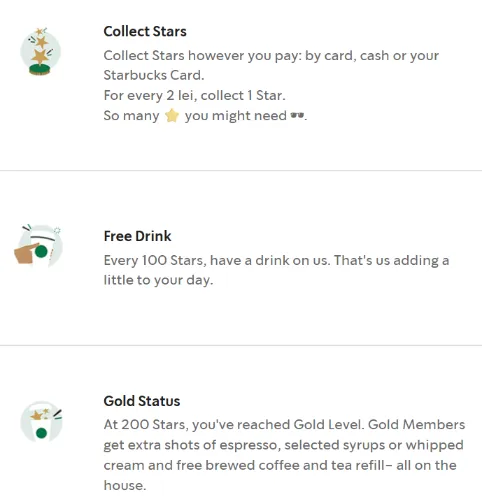
Take Starbucks’ example that turns purchase history into personalized challenges and rewards that keep customers coming back with genuine enthusiasm.
3. Loyalty Programs
Loyalty programs give customers a reason to keep choosing your brand after the first purchase. The best ones create value through rewards, access, recognition, and experiences that make customers feel closer to the brand.
They also keep the relationship active through regular touchpoints. Points, perks, referrals, early access, and member-only offers can turn repeat buying into a more intentional habit.
For example, Nike Connected Membership gives members access to exclusive event invites, discounts, and brand moments that make loyalty feel more personal than a standard points program.
4. Subscription & Replenishment Programs
Subscriptions work because they remove the repeat purchase decision. When customers receive what they need on schedule, they have fewer reasons to compare options, delay the order, or drift toward a competitor.
The model earns loyalty through three things: affinity, convenience, and value. Members feel part of something, delivery arrives without effort, and the price is better than buying one-off. This combination builds routine, which is remarkably hard to disrupt.
For you, the payoff is predictable recurring revenue, and for customers, it removes one more decision from their day.
5. Customer Experience Optimization
Retention starts long before a loyalty program. Customers decide to stay through the everyday moments that make buying, using, and getting support feel easy.
Those moments show up in:
- How smoothly someone onboards
- How little friction they hit when buying again
- How consistent the experience feels across the app, website, email, or support
The brands that treat customer experience seriously build retention into their revenue models. They track CLV and CSAT with the same urgency as new sales, and treat customer success as a growth function.
6. Customer Feedback & Voice of Customer
Listening to customers is table stakes. Acting on what they say is where retention actually happens. Companies with strong VoC programs see 55% higher retention rates than those without because they act on the answers. When customers see their input drive real decisions, trust grows.
Orange Telecom shows how practical this can get. The company saved €200,000 in churn in a single year by combining customer feedback with AI-driven analysis to identify at-risk customers early. When teams act on feedback systematically, listening becomes a revenue strategy.
7. Win-Back Campaigns
Churn does not always mean the relationship is over. Sometimes it means the customer paused, forgot, lost momentum, or no longer saw enough value to return.
Win-back campaigns exist to close that gap. They identify at-risk customers early, then re-engage inactive buyers before they fully move on. That timing matters because lapsed customers already know your product and have trusted it before.
They also give you a useful head start. A returning customer may need a clearer reminder, a better offer, a product update, or a reason to revisit the value they missed.
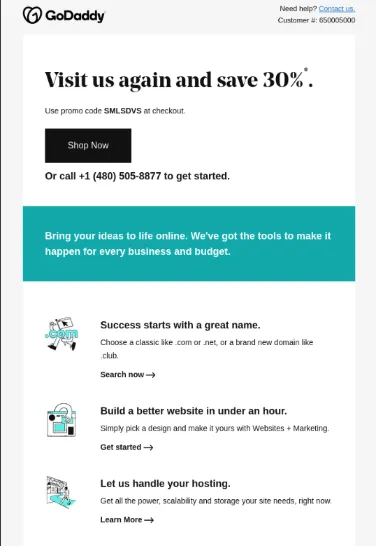
GoDaddy's approach illustrates this cleanly. They revived inactive customers with a straightforward 30% discount on new purchases: a clear, effective nudge that brought users back.
Key Retention Metrics Acquisition Teams Should Own
At 9AM, we look at retention metrics as part of the full growth system, instead of a separate reporting layer. Below, we have shared the key numbers acquisition teams should own once a customer makes the first purchase.
Key Retention Metrics That Actually Matter
| Metric | What It Measures | Why It Matters |
|---|---|---|
| Repeat Purchase Rate | % of customers who buy again | Core signal of product-market fit |
| Customer Lifetime Value (CLV) | Total revenue per customer | Validates acquisition spend |
| Churn Rate | % of customers lost over a period | Reveals retention program effectiveness |
| Customer Risk Score | % of customers who will stop using your product/service or stop buying | Allows targeting the right people |
| Retention Rate | % of customers retained | Tracks relationship durability |
| Net Revenue Retention | % of recurring revenue retained from existing customers over a specific period | Reveals growth in the value of existing customers |
| CLV:CAC Ratio | Revenue vs cost to acquire | Determines channel sustainability |
| Monthly Recurring Revenue | Predictable monthly income from subscriptions | Shows the value of keeping customers |
| Annual Recurring Revenue | Predictable yearly income from subscriptions | Reveals YoY sustainable growth in customer base |
How to Build a Retention-First Mindset in an Acquisition Team
The simplest shift in retention thinking is also the most overlooked.
Stop measuring success only by how many new customers you acquired. Start measuring it by how much value those customers create after the first purchase.
This means tying goals to LTV and reviewing acquisition performance by how well each cohort retains. It also means building feedback loops between your paid media, CRM, CX, and product teams.
These functions generate signals that are genuinely useful to each other. A spike in churn may point back to a campaign that attracted the wrong audience. A product complaint in support may reveal a retention risk before it turns into lost revenue.
Most importantly, treat retention as a revenue line, something you forecast, invest in, and optimize. The brands that do this retain more customers and grow more predictably.
Read Next: CAC Payback Period: LTV Modeling That Finance Will Trust
How 9AM Helps Brands Improve Retention Marketing
If you want a smarter approach to keeping customers, our team at 9AM can help you build retention strategies that grow steadily. We work across customer lifecycle strategy, email and SMS campaigns, and paid media informed by LTV, connecting every stage of the customer journey into a system you can actually see.
Customer acquisition and retention, measured together, with reporting that tells you what's working and where customers are slipping away.
Ready to turn your retention into a catalyst for growth? Book your strategy call!
FAQs
Why do most growth teams underinvest in retention?
Growth teams underinvest in retention because acquisition is easier to track, easier to report, and usually has clearer budget ownership. Retention needs input from CRM, product, CX, and analytics, so it mostly gets delayed. As a result, teams keep funding new customer volume while missing the revenue already sitting inside existing customers.
What is a good customer retention rate?
A good retention rate depends on the industry and the business model, but a median rate of around 75% is generally considered healthy. SaaS companies usually aim for 85–95% monthly retention, while ecommerce may see 25–40% repeat‑purchase retention. What matters most is improving your baseline over time. If retention is rising, customer value, revenue predictability, and growth efficiency rise with it.
Which retention marketing channels deliver the highest ROI?
Email marketing consistently delivers the strongest ROI due to its low cost, direct reach, and high level of personalization. SMS and push notifications perform well for timely, high‑intent messages. Paid retargeting, in-app messaging, and loyalty programs can also perform well when they target known customers with timely, relevant offers.
How does 9AM help brands with digital retention marketing?
At 9AM, we build retention marketing systems that keep customers buying, reduce churn, and grow lifetime value. Our team connects the right channels (email, SMS, paid, lifecycle programs) to the right moments in the customer journey, so your retention efforts grow.
Does 9AM provide transparent insight into its retention and performance marketing approach?
Yes. We build dashboards that make retention performance visible and actionable: churn rates, repeat purchase frequency, CLTV, campaign attribution, and channel contribution, all in one place. You'll always know what's working, what isn't, and where the next opportunity is.
Appendix ▼
- Customer Retention Statistics — Rivo
- Cost of Customer Acquisition vs Retention — Yotpo
- Customer Retention — The Marketing Centre
- Customer Retention vs Acquisition — Forbes
- Customer Acquisition vs Retention — ClearlyRated
- Customer Retention vs Acquisition Cost — Releva
- Why CLV/CAC Matters — Blend Commerce
- Retention Marketing Strategies — Lyxel & Flamingo
- Next Best Experience — McKinsey
- Email Marketing vs Paid Campaign — MLeads
- SMS Marketing Statistics — Falkon SMS
- Push Notifications Guide — Pugpig
- Personalized Marketing & Retention — E-Cens
- Retention with Personalization — Gwosevo
- Starbucks Rewards
- Voice of the Customer — Tallyfy
- Orange Case Study — Staffino
- Cordial Image Example