HIPAA Compliant Marketing: Privacy-First Growth for Health Brands
Discover HIPAA compliant marketing strategies that help health brands grow while protecting patient data and meeting privacy rules.

Healthcare data continues to be the costliest to compromise. IBM’s Cost of a Data Breach Report found that the average breach in the healthcare sector costs approximately $7.42 million, more than any other industry.
Meanwhile, health brands are under pressure to grow faster through digital marketing, lead generation, and automated communications.
HIPAA-compliant marketing is the operational baseline for survival. Regulators are actively pursuing organizations that mishandle customers data, and the financial consequences dwarf most marketing budgets.
However, compliance should not be viewed as a constraint. When privacy is engineered into marketing systems from the outset, it becomes a competitive advantage that strengthens trust and drives customer acquisition.
This guide breaks down exactly how to build a privacy-first marketing engine that scales without risk.
P.S. Worried your current campaigns might expose protected health information without you realizing it? At 9AM, we run HIPAA-compliant marketing campaigns for healthcare and wellness brands that want measurable growth without compliance risk. Book a strategy call now!
TL;DR
- HIPAA governs every marketing tool that touches patient data, including pixels, analytics platforms, and CRM systems. No Business Associate Agreement means no legal basis for data sharing.
- HIPAA penalty tiers reach up to $2,190,294 per violation category for willful neglect left uncorrected. OCR resolved 21 enforcement actions in 2025, collecting over $8.3 million in penalties.
- 81% of consumers say how a brand handles their data reflects how it respects them as a customer.
- Health brands that build on first-party data, server-side infrastructure, and granular consent are better positioned to grow and far harder to penalize.
What Is HIPAA Compliant Marketing?
HIPAA-compliant marketing means structuring every marketing activity that touches patient information in a way that meets federal privacy and security requirements. It is not limited to clinical systems. It applies to websites, ad platforms, CRMs, email tools, call tracking software, and any vendor that processes protected health information.
This applies to hospitals and clinical providers, as well as to digital health platforms, telehealth companies, genetic testing services, and wellness brands that collect identifiable health data.
The Health Insurance Portability and Accountability Act (HIPAA) was enacted in 1996 to establish federal standards for how healthcare organizations handle protected health information.
In 2025, its scope extends well beyond medical records. If your campaigns collect, store, or transmit identifiable patient data, HIPAA governs how that data moves.
When Protected Health Information (PHI) is collected or shared with tracking vendors without proper authorization, that is a HIPAA violation. This is where most teams get exposed. Many assume their analytics or CRM setup is harmless. It is not.
Any third-party vendor, such as an email platform, analytics tool, call tracking service, or CRM, that handles PHI on behalf of a covered entity qualifies as a Business Associate. A written Business Associate Agreement (BAA) must be in place before that vendor can access PHI. No BAA means no legal basis for data sharing.
If your digital marketing campaigns touch patient data, HIPAA governs how that data moves.
Core Principles for HIPAA-Compliant Marketing
HIPAA-compliant marketing runs on a small set of non-negotiable principles. When even one is missing, your entire marketing stack becomes exposed.
Below, we have listed the core principles you must operationalize.
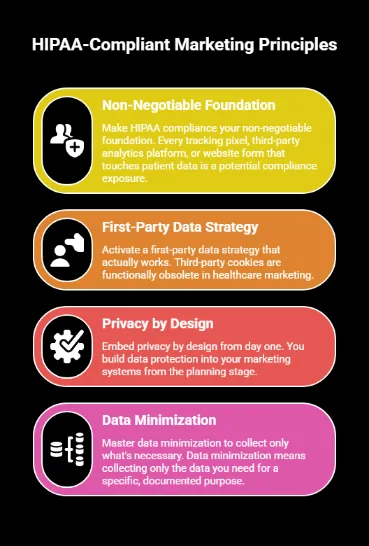
1. Make HIPAA Compliance Your Non-Negotiable Foundation
HIPAA's role in modern marketing goes beyond protecting files. Every tracking pixel, third-party analytics platform, or website form that touches patient data is a potential compliance exposure, and regulators are not giving organizations the benefit of the doubt.
Penalty tiers range from $145 per violation at the low end to $2,190,294 per violation for willful neglect left uncorrected. And because penalties are assessed per violation type, not per incident, a single misconfiguration can trigger multiple violations across multiple provisions.
For wellness and consumer-facing health brands, enforcement may not appear first as a government action. It usually shows up as ad account restrictions, payment processor scrutiny, platform bans, or public trust damage that limits your ability to scale.
As per our experience working with various health brands, the real danger for marketing teams is "shadow data." This means PHI that leaks through tools never designed for a HIPAA environment.
The most common culprits:
- Standard third-party pixels embedded on healthcare websites.
- Unchecked website forms that capture health-related inputs.
- Tag Management systems that route data to unauthorized ad networks.
Advocate Aurora Health used Meta Pixel and Google Analytics on its website, patient portal, and scheduling app to better understand patient behavior.
As a result, the protected health information of millions of patients was transmitted to third parties without authorization. Advocate Aurora Health settled the case for $12.25 million.
2. Embed Privacy by Design from Day One
Privacy by design means you build data protection into your marketing systems from the planning stage. You do not retrofit compliance after campaigns go live. Instead, you map every user touchpoint and confirm consent is captured, documented, and enforceable before data moves anywhere.
In our experience, this is where most teams fall short. They launch first and review later. That gap is where exposure begins.
In practice, this requires:
- Auditing your MarTech stack for tools that lack BAAs before launch
- Confirming your Tag Management setup isn't forwarding PHI to ad platforms
- Ensuring your Consent Management Platform blocks non-consented tracking at the source
- Documenting consent at every data collection point across your Content Management System
When user privacy is engineered upfront, data leaks become less likely. You gain control before regulators ever need to ask questions.
3. Master Data Minimization to Collect Only What's Necessary
Data minimization means collecting only the data you need for a specific, documented purpose. You avoid speculative data capture and resist the urge to gather information simply because your system allows it.
For regulated healthcare marketing, this discipline matters beyond compliance. Every data point you don't store shrinks the risk of a potential breach.
A Customer Data Platform built on purposeful, consented data produces cleaner campaign signals than one bloated with unnecessary fields. When fewer data variables flow through your MarTech stack, you manage fewer protected health information exposures. This makes audits easier and enforcement questions easier to answer.
To sum up, if your appointment booking flow doesn't need a patient's insurance ID to function, don't collect it. Extra fields rarely improve marketing performance; they usually increase liability.
4. Activate a First-Party Data Strategy That Actually Works
Third-party cookies are functionally obsolete in healthcare marketing. This affects hospital systems and consumer-facing wellness brands alike. Ad platforms are tightening their data policies, and no reputable ad network will sign a BAA for their standard ad products. PHI cannot legally travel through conventional tracking channels.
This is where many teams miscalculate. They attempt to replicate retail marketing tactics inside a regulated environment. This approach creates exposure.
Instead, you need a structured zero-party and first-party data strategy. This includes information patients and prospects actively share with you for a defined purpose.
The most effective collection mechanisms include:
- Preference centers let users self-select communication preferences and health interests.
- Double opt-in workflows for all health-related newsletters.
- Patient portal interactions in secure, authenticated environments capture accurate, legally defensible data.
- Health quizzes and assessments via tools like JotForm or Formstack, configured with HIPAA-compliant settings and BAAs in place.
For example, one of our clients, Mindbloom, which provides ketamine therapy, uses a structured eligibility and intake survey to guide prospective patients through a qualification process.

Side note: Tools like JotForm and Formstack can support compliant data collection, but only on their HIPAA-eligible plans. A signed BAA and proper HIPAA configuration are required to ensure all collected data remains compliant.
Why a HIPAA-Compliant Customer Data Platform (CDP) Matters
Before data reaches analytics platforms, ad targeting systems, or media buying channels, it must first be unified inside a HIPAA-compliant Customer Data Platform. This is the only place where PHI is permitted to exist in its raw, unified form.
Unlike a traditional Data Management Platform (DMP), which was designed to push data outward to ad networks, a compliant CDP governs access and enforces permission controls before anything moves.
Beyond data unification, it must also enforce:
- Data residency: keeping PHI within defined geographic boundaries
- Encryption at rest: a hard requirement under the HIPAA Security Rule
Tools like Tealium or self-hostable environments built within a compliant cloud infrastructure can support this foundation.
How to Build a Tech Stack That Supports HIPAA-Compliant Marketing
This is where most healthcare and wellness brands underestimate complexity. Tools that work perfectly in other industries can create immediate exposure in a regulated environment.
You need a tech stack designed specifically for HIPAA-governed marketing. Here is how to build it correctly.
1. Implement a Signal Gateway
This is the most critical step in the entire tech stack.
A Signal Gateway sits between your CDP and your ad networks. It performs de-identification and redaction before any signal leaves your secure environment.
For example, a raw signal like "User diagnosed with diabetes scheduled an appointment" becomes "unknown_user_id performed conversion_event_A" by the time it reaches Meta or Google.
Why does this matter so much?
This distinction matters because ad networks do not sign business associate agreements for their standard advertising products. If protected health information flows into those systems, you have a violation.
A properly configured gateway ensures:
- No protected health information exits your environment
- Only de-identified data is shared
- Compliance with HIPAA Security Rule
De-identification must follow one of two recognized methods. The Safe Harbor Method removes 18 specific identifiers defined under HIPAA. The expert determination method relies on statistical analysis to confirm that the risk of re-identification is sufficiently low.
From what we have seen, this is the control layer many marketing teams skip. They connect their CDP directly to ad platforms and assume configuration settings will handle compliance. That assumption creates risk.
2. Use Server-Side Tracking for Delivery
Server-side tracking is the delivery truck, not the security guard. Once the Signal Gateway has scrubbed PHI, CAPI (Meta's Conversions API) and GTM Server-Side deliver clean, anonymized signals directly to ad platform servers. This bypasses browser ad-blockers, cookie restrictions, and iOS-driven signal loss.
Organizations seeking maximum data control can self-host their server-side infrastructure on a HIPAA-eligible cloud platform. Google Cloud Platform, AWS, or Azure are the most common choices, all supporting the data residency, encryption, and audit logging configurations HIPAA environments require.
Side note: Server-side tracking is only compliant because the Gateway did its job first. Implementing GTM Server-Side or CAPI without a scrubbing layer upstream doesn't make your data flows safe.
It just changes the route PHI travels. GTM Server-Side is not HIPAA-compliant out of the box. It requires custom configuration to filter PHI before data reaches any downstream platform.
3. Implement Robust Consent Management Platforms (CMPs)
A cookie banner is not a compliance strategy. Healthcare organizations and wellness brands must capture granular, enforceable consent. Marketing, analytics, and functional tracking should exist in clearly defined categories that users actively accept or decline.
This is where many teams oversimplify. They install a banner and assume compliance is handled. However, it is not.
According to Cisco's Consumer Privacy Survey, 81% of consumers agree that how an organization treats their personal data reflects how it respects them as a customer.
A robust Consent Management Platform blocks non-consented tracking at the source and generates consent artifacts. That documentation is your first line of defense in any Office for Civil Rights audit.
How to Operationalize Privacy-First Marketing for Growth
Principles and infrastructure matter, but execution determines whether your strategy holds under pressure. You need campaign practices that drive revenue while protecting patient and consumer data.
In practice, executing compliant campaigns requires both regulatory awareness and performance discipline. At 9AM, we apply this framework across paid media, lifecycle marketing, and creative development for health and wellness brands operating in regulated environments.
Here is how to do that responsibly.
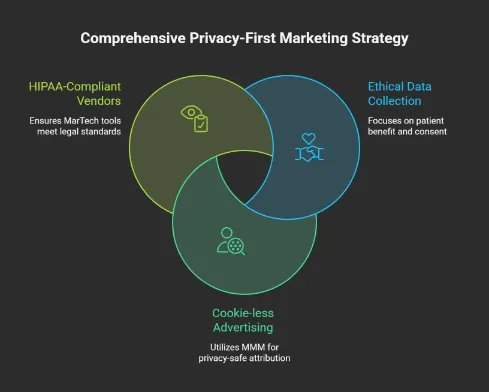
1. Ethical Data Collection for Email and Social Channels
The permission you ask for shapes the trust you earn. Whether you operate a hospital system, digital health platform, or wellness brand, your data collection language should focus on user benefit, not targeting advantages
The regulatory framework applies differently depending on your structure, but the data protection responsibility remains the same.
A few rules that apply across every channel:
- Use double opt-in for all health-related newsletters. It confirms genuine consent and creates a documented audit trail.
- Never build lookalike audiences from patient data. Ad platforms use uploaded lists to find similar users, but in healthcare, that process exposes PHI to platforms that will not sign a BAA.
- Keep PHI out of email subject lines, preview text, and sender names.
Additionally, treat social media and paid ads as awareness channels only. They should never receive identifiable patient lists.
2. Reimagine Advertising and Attribution Without Cookies
Pixel-based, user-level attribution is increasingly unreliable in healthcare. The shift is toward privacy-preserving attribution models that measure performance without tracking individuals.
Media Mix Modeling (MMM) is one of the most practical alternatives.
Over half of US marketers now use MMM, with 30.1% ranking it as the best method for identifying drivers of business outcomes, ahead of web analytics, incrementality testing, and third-party multi-touch attribution.
MMM works from aggregated data, with no user-level tracking required, making it a clean fit for HIPAA-regulated environments.
For health organizations and wellness brands, the practical shift looks like this. Measure channel-level impact through MMM, supplement with privacy-safe programmatic partners. Retire attribution approaches that depend on individual-level health data.
This transition requires discipline. However, it creates defensible performance measurement.
3. Partner With Vendors That Respect HIPAA-Compliant Marketing
Every vendor in your MarTech stack that touches patient data is a legal liability without a signed BAA. This includes tools most marketing teams treat as standard, from GA4 in its default configuration to CRM platforms and most email service providers.
These platforms are not HIPAA-compliant marketing tools out of the box. Signing a BAA transfers shared responsibility to the vendor, but only if the vendor is actually willing to sign one.
We recommend conducting an annual vendor risk assessment across your full MarTech stack. For each tool, confirm:
- A BAA is in place and current
- The vendor's data handling practices meet HIPAA Security Rule standards
- The tool supports role-based access control and audit logging
- PHI does not flow through the tool unless it is specifically configured for HIPAA compliance
If you need support executing campaigns in regulated environments, 9AM offers HIPAA-compliant healthcare marketing services for health and wellness brands that want to grow responsibly.
How to Measure Success in a World of HIPAA-Compliant Marketing
When privacy comes first, your definition of performance needs to evolve. You can still grow; you simply measure growth differently.
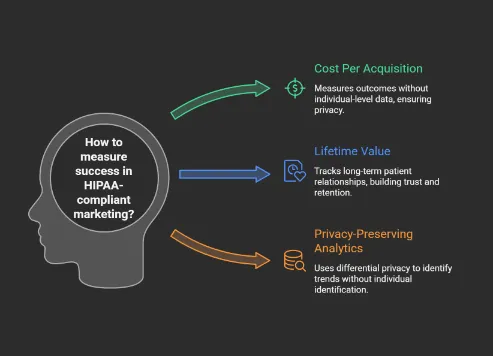
Redefine KPIs Beyond Cost Per Lead
Tracking granular lead behavior creates PHI exposure. Cost Per Acquisition (CPA) is the safer alternative. It measures outcomes without requiring individual-level behavioral data to flow through non-compliant tools.
Forhealthcare organizations and wellness brands built on trust, Lifetime Value (LTV) is the ultimate north star metric. Customers who trust your brand stay longer, refer more, and cost less to retain. Privacy-first marketing builds the kind of relationship that makes LTV a meaningful number.
From what we have seen, brands that anchor performance to acquisition quality and retention stability build stronger long-term growth.
Gain Insights With Privacy-Preserving Analytics
You do not need to track individuals to understand performance patterns. Privacy-preserving analytics allow you to evaluate trends without exposing identifiable data.
Differential privacy adds statistical noise to datasets so individual users cannot be identified, while aggregate trends remain visible and actionable. You can still spot which campaigns drive appointment bookings or which content drives conversions without knowing who specifically clicked.
Tools like Mixpanel and Heap, configured with HIPAA-compliant settings and signed BAAs, support this kind of aggregated reporting. Looker Studio can be used for visualization when connected to de-identified data sources. Siteimprove.ai offers built-in privacy controls designed for regulated industries.
The principle is straightforward: measure patterns instead of people.
Future-Proof Your Health Brand with 9AM's HIPAA Compliant Marketing
Healthcare data breaches cost millions per incident. Enforcement continues to increase. Meanwhile, most martech tools were not built for regulated health environments.
Growing in this space requires clarity. You need campaigns that acquire customers and patients without exposing protected health information.
At 9AM, we run HIPAA-compliant marketing campaigns for healthcare and wellness brands that want measurable growth without unnecessary risk.
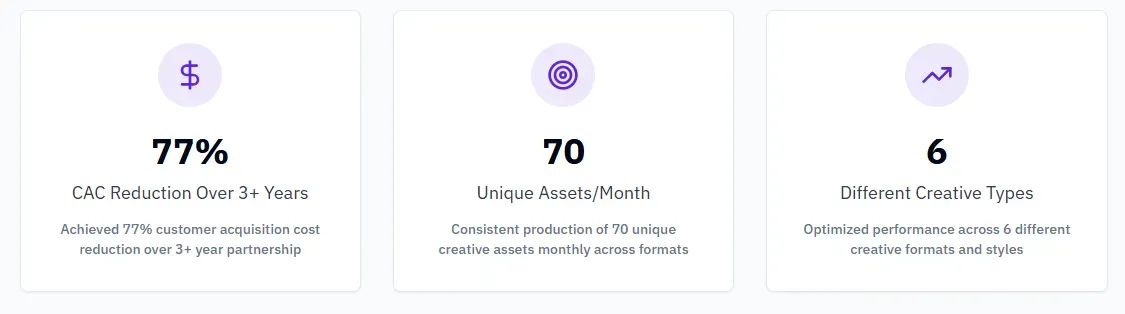
For example, with GenomeLink, a DNA analysis platform operating in the genetic testing space, we reduced customer acquisition cost by 77%. We scaled user acquisition across five channels while maintaining strict data integrity controls.
If your health brand is ready to scale responsibly, book a strategy call with 9AM.
Frequently Asked Questions
1. What does privacy-first growth mean for health brands?
Privacy-first growth means building marketing systems where patient data is collected, stored, and used only with proper consent and HIPAA authorization. Rather than treating compliance as a cost, health brands use it as a foundation for patient trust, durable first-party data, and sustainable acquisition that does not depend on third-party tracking.
2. What is the privacy-first approach?
A privacy-first approach means data protection is built into every marketing decision from the start, not added after the fact. For health brands, this includes implementing a HIPAA-compliant Customer Data Platform, obtaining granular patient consent, minimizing data collection, and ensuring every vendor in the MarTech stack has a signed Business Associate Agreement.
3. Why is privacy so important in healthcare?
Healthcare data is among the most sensitive information a person can share. A breach erodes the patient trust that health brands depend on. With average breach costs at $7.42 million and OCR enforcement accelerating, privacy is both a legal requirement and a business imperative.
4. Does 9AM work with both healthcare providers and wellness brands?
Yes. 9AM supports healthcare providers, digital health companies, and wellness brands operating in regulated environments. We have worked with brands such as Abbott, Mindbloom, Nurse.com, Nestlé Health Science, and Nuun to execute compliant, performance-driven campaigns. Our approach protects sensitive data while driving measurable growth.
Appendix
- https://www.hipaaguide.net/2025-cost-data-breach/
- https://www.hipaajournal.com/december-2025-healthcare-data-breach-report/
- https://www.hhs.gov/hipaa/for-professionals/privacy/laws-regulations/index.html
- https://cphs.berkeley.edu/hipaa/hipaa18.html
- https://www.zendesk.com/blog/customer-data-platform/
- https://www.hhs.gov/hipaa/for-professionals/special-topics/de-identification/index.html
- https://www.cisco.com/c/dam/en_us/about/doing_business/trust-center/docs/cisco-consumer-privacy-survey-2022.pdf
- https://www.emarketer.com/content/media-mix-modeling-attention-metrics-2025/